10 October 2026 · Dr Alan Teh
Why this review
For a Malaysian doctor who wants a free, cited, clinician-only AI tool today, Vera Health is the closest like-for-like replacement for OpenEvidence, and Heidi Health is the best choice when the question arises inside a patient consultation. Local platforms (HEMI Health, DOBBS AI on Qmed, Docquity's AskDx) add Malaysian guidelines and peer context that the global tools lack.
OpenEvidence set the standard for free, literature-grounded clinical answers, but it is effectively closed to us. Access requires US NPI verification, which locks out clinicians in Asia, and the company withdrew from the UK and EU in April 2026 citing AI regulatory uncertainty. Its content also leans on US guidelines and FDA approvals.
Why not just use ChatGPT, Claude or Gemini?
The consumer apps of general-purpose LLMs are excellent writers and reasoners, but they are the wrong place for identifiable patient information:
- Data handling is not built for clinical records. Consumer tiers may retain conversations and, depending on settings, use them to improve models. There is no healthcare data-processing agreement with an individual doctor.
- PDPA obligations sit with you. Under the Personal Data Protection Act 2010, health data is "sensitive personal data" with stricter consent and transfer rules. Pasting a patient's name, IC number or full history into a public chatbot is a disclosure you may not be able to justify.
- Answers are not reliably grounded. General models can produce confident, uncited, or fabricated references. Clinical tools retrieve from guidelines and peer-reviewed literature and show their sources.
The practical rule: use general LLMs for de-identified, non-clinical work (writing, teaching, admin). Use a purpose-built clinical tool for anything touching a real patient, and still remove identifiers wherever the tool doesn't need them.
How the tools were rated
Each tool is scored 1–5 on six criteria, weighted for a Malaysian clinician:
| Criterion | Weight | What a 5 looks like |
|---|---|---|
| Evidence quality | 25% | Answers cite guidelines and peer-reviewed papers inline; evidence is graded |
| Privacy & data handling | 20% | Clinician-only, healthcare-grade compliance (HIPAA/GDPR/PDPA), no ad targeting on clinical queries |
| Free tier | 15% | Core features genuinely free with no hard cap |
| Availability in Malaysia | 15% | Open sign-up for Malaysian doctors, no foreign licence needed |
| Local relevance | 15% | Uses Malaysian CPGs, local drug availability, Malay/rojak language |
| Workflow fit | 10% | Mobile app, works mid-consult, scribe or EMR links |
Ratings reflect publicly available information and hands-on impressions as of the date above. Vendors change plans and features often; verify on each site before relying on a feature.
The tools, one by one
1. Heidi Health (Heidi Evidence + Ask Heidi)
The best all-round choice for a Malaysian clinician, because it is the only tool here built to handle patient data and answer evidence questions in the same place.
- What it is: an Australian ambient AI scribe that now includes Heidi Evidence, a cited clinical answer engine. Answers carry inline citations, prioritise regionally aligned guidance and have no sponsored results.
- Free tier: the Free plan includes unlimited transcription, standard templates and Evidence with citations. Ask Heidi, custom templates and form filling share a cap of 10 actions a month.
- Privacy: designed from the start for consultation audio and notes, with published HIPAA, GDPR and AU/NZ compliance pages. Outside the UK and EU, Evidence also works inside Ask Heidi during a consult.
- Malaysia: fully available. KPJ Healthcare is rolling Heidi out across its 27 hospitals, and Heidi has regional hubs in Singapore and Hong Kong.
- Mobile apps: iPhone (App Store) · Android (Google Play)
- Limits: premium sources, Source Control and the personal evidence library are paid. Evidence depth is good but narrower than a dedicated literature engine.
2. Vera Health
The closest like-for-like replacement for OpenEvidence: a free, cited, evidence-graded answer engine open to clinicians worldwide.
- What it is: a clinical answer engine drawing on 60M+ peer-reviewed papers and guidelines, with evidence grading, 900+ calculators, a Deep Research mode and multilingual support.
- Free tier: free for licensed clinicians and medical students globally, no geographic restriction.
- Privacy: the privacy policy says personal data is not used to train its models and offers a HIPAA BAA to covered entities. But services are hosted in the US, web and device data are shared with advertising and analytics partners, and de-identified inputs may be aggregated and shared with business or research partners. Treat it as a reference tool: ask de-identified questions only.
- Malaysia: open sign-up, web and mobile apps.
- Mobile apps: iPhone (App Store) · Android (Google Play)
- Limits: US-centric defaults; no Malaysian CPGs. Most comparative claims about it come from Vera's own blog.
3. DOBBS AI (dobbs-space.qmed.ai)
The most locally relevant option, built on Malaysian Clinical Practice Guidelines rather than US literature.
- What it is: a clinical AI assistant for Malaysian doctors under the DOBBS brand, powered by Qmed Asia. It draws on Qmed's stack, including AskCPG, which answers from Malaysia's CPGs in English, Malay, Chinese or mixed-language queries, plus calculators, drug interactions and document generation.
- Evidence: grounded in local CPGs, which Google Research has cited as a MedGemma deployment example. Narrower than a full literature engine for rare or fast-moving topics.
- Free tier: free for DOBBS members.
- Privacy: data is hosted in Malaysia and is not used to train models. As a Malaysian company, Qmed is directly accountable under PDPA.
- Malaysia: built for Malaysian practice; requires sign-in.
- Mobile apps: none yet; web app only at dobbs-space.qmed.ai, which works in a phone browser.
- Disclosure: the author is involved with the DOBBS Community.
4. AskDx by Docquity
A regional, peer-network option with growing guideline content, but its business model calls for extra caution with clinical inputs.
- What it is: Docquity is a Singapore-based network claiming 500K+ verified doctors across 9 Asian markets, with an office in Malaysia. Its AI assistant, AskDx (app.joindx.ai), answers clinical questions and is adding society guidelines, such as Indonesian neurology guidance via PERDOSNI.
- Free tier: free for verified doctors.
- Privacy: Docquity states openly that it sells insight derived from doctors' activity to life-sciences companies. Never enter patient identifiers, and assume your queries inform pharma analytics.
- Malaysia: available, verification required.
- Mobile apps: iPhone (App Store) – JoinDx · Android (Google Play) – JoinDx
- Limits: source transparency and evidence grading are less mature than Vera or Heidi; Malaysian-specific guideline coverage is not clearly documented.
5. HEMI Health (MedPlanner)
The Malaysian answer to Heidi: a scribe-plus-assistant built in Kuala Lumpur, with a unique medicolegal angle, but its evidence engine is less transparent than Heidi's or Vera's.
- What it is: an AI clinical assistant from MedPlanner Sdn Bhd, founded by NHS-trained consultant paediatrician Dr Ezam Mat Ali, a former medicolegal adviser to the Medical Protection Society. It launched for clinicians in Malaysia and the UK in June 2026.
- Features: ambient scribe, citation-linked clinical Q&A, file interpretation (skin photos, chest X-rays, lab reports, PDFs) and offline recording. Its differentiator is a medicolegal suite: clinical reasoning documentation, complaint-response support and reflective practice records.
- Evidence: runs on a proprietary "HEMI AI" engine combining multiple LLMs with retrieval from a clinical knowledge base rather than the open web. Which guidelines and journals it draws on, and whether Malaysian CPGs are included, is not publicly documented.
- Free tier: a Free plan sits alongside paid Plus, Pro and Enterprise tiers; the free plan's limits are not published on the pricing page.
- Privacy: the strongest stated compliance list here for a local tool: PDPA, GDPR, HIPAA, NHS DSPT and DCB0129, Cyber Essentials Plus. As a Malaysian company it is directly accountable under PDPA. To confirm: data hosting location.
- Malaysia: fully available; Bahasa Malaysia supported. MedPlanner also makes AskHEMI, a separate patient-facing app, which should not be confused with the clinician product.
- Mobile apps: Android (Google Play) · iPhone: no App Store listing found; use the web app at app.hemihealth.ai
- Limits: new (months old), little independent evaluation, and the evidence sources behind its answers need to be verified before relying on them like Vera or Heidi Evidence.
Ratings
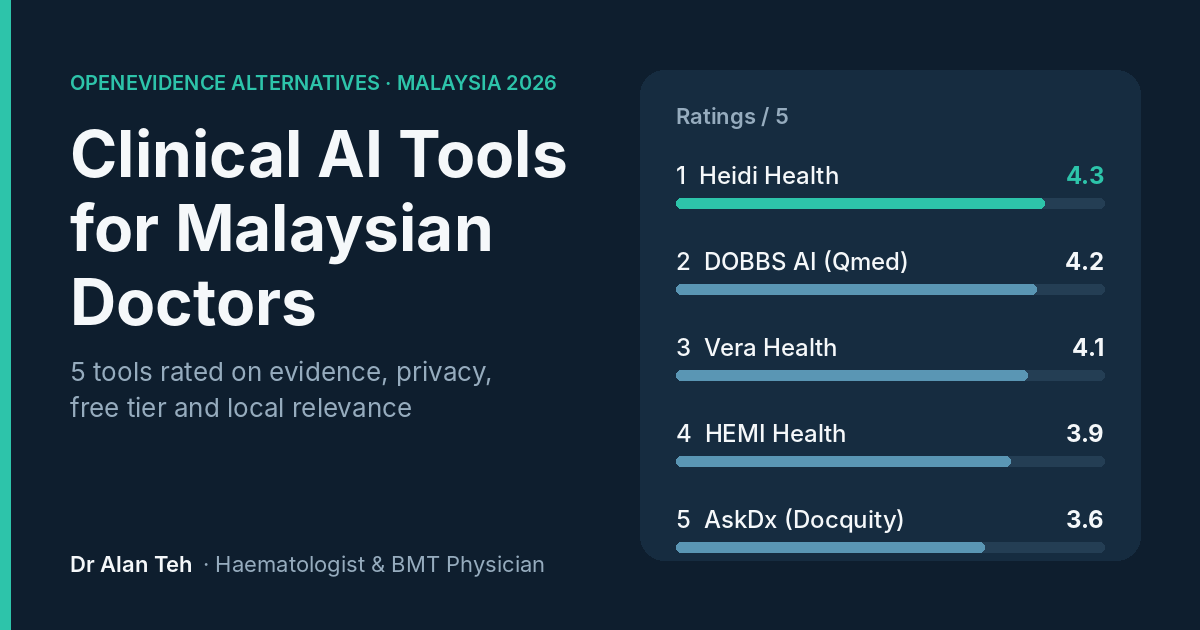
Heidi Health scores highest overall (4.3/5) on the strength of privacy and workflow; Vera Health leads on pure evidence quality; DOBBS AI leads on local relevance.
| Rank | Tool | Evidence (25%) | Privacy (20%) | Free tier (15%) | Malaysia access (15%) | Local relevance (15%) | Workflow (10%) | Weighted score /5 |
|---|---|---|---|---|---|---|---|---|
| 1 | Heidi Health | 4 | 5 | 4 | 5 | 3 | 5 | 4.3 |
| 2 | DOBBS AI (Qmed) | 3 | 5 | 4 | 5 | 5 | 3 | 4.2 |
| 3 | Vera Health | 5 | 3 | 5 | 5 | 2 | 4 | 4.1 |
| 4 | HEMI Health | 3 | 4 | 3 | 5 | 4 | 5 | 3.9 |
| 5 | AskDx (Docquity) | 3 | 2 | 5 | 5 | 4 | 3 | 3.6 |
Which to use, and how to use it safely
Most Malaysian doctors will be best served by a pair: Heidi for anything involving a real patient, plus Vera or DOBBS AI for quick reference questions.
| If you need… | Use | Why |
|---|---|---|
| Evidence during a consultation, with the patient's context | Heidi Health | Built to hold patient data; Evidence sits inside the session |
| A free OpenEvidence-style literature answer | Vera Health | Broadest corpus, evidence grading, free worldwide |
| A Malaysian-built scribe with medicolegal documentation | HEMI Health | Local company, PDPA-accountable, reasoning and complaint-response tools |
| What the Malaysian CPG says | DOBBS AI | Answers from local CPGs, handles Malay and rojak queries |
| Peer discussion plus AI answers in a regional network | AskDx | Large Asian doctor community; strictly de-identify your data before use |
Safe-use rules for any of these tools:
- Strip identifiers by default. Name, IC, MRN, address, phone and exact dates are rarely needed to answer a clinical question.
- Read the privacy policy once. Check where data is hosted, whether inputs train models, and whether data is shared with advertisers or pharma.
- Open the citation. Confirm the source says what the answer claims, especially doses.
- Check against local practice. US or European answers may cite drugs or thresholds that differ from Malaysian CPGs and formularies.
- Document your own judgement. The AI informs the decision; the doctor remains accountable under MMC guidance.
- Use hospital-approved tools first. If your hospital has an enterprise agreement (e.g. a contracted scribe), that governs patient data, not a personal free account.
Sources
- OpenEvidence review and availability — Fast.io
- Tandem CDS vs OpenEvidence (UK/EU withdrawal) — iatroX
- Which Heidi plan is right for you? — Heidi Help Centre
- Heidi Evidence update — Heidi changelog
- Heidi targets more Asia-Pacific health systems — MobiHealthNews
- Vera Health privacy policy — Vera Health
- Best free clinical AI 2026 and Best AI assistant for clinicians — Vera Health (vendor)
- DOBBS AI — DOBBS / Qmed Asia
- Qmed AskCPG and Qmed research and white papers — Qmed Asia
- About Docquity — Docquity
- HEMI Health — MedPlanner
- MedPlanner launches HEMI AI tools for UK & Malaysia — eCommerceNews Asia