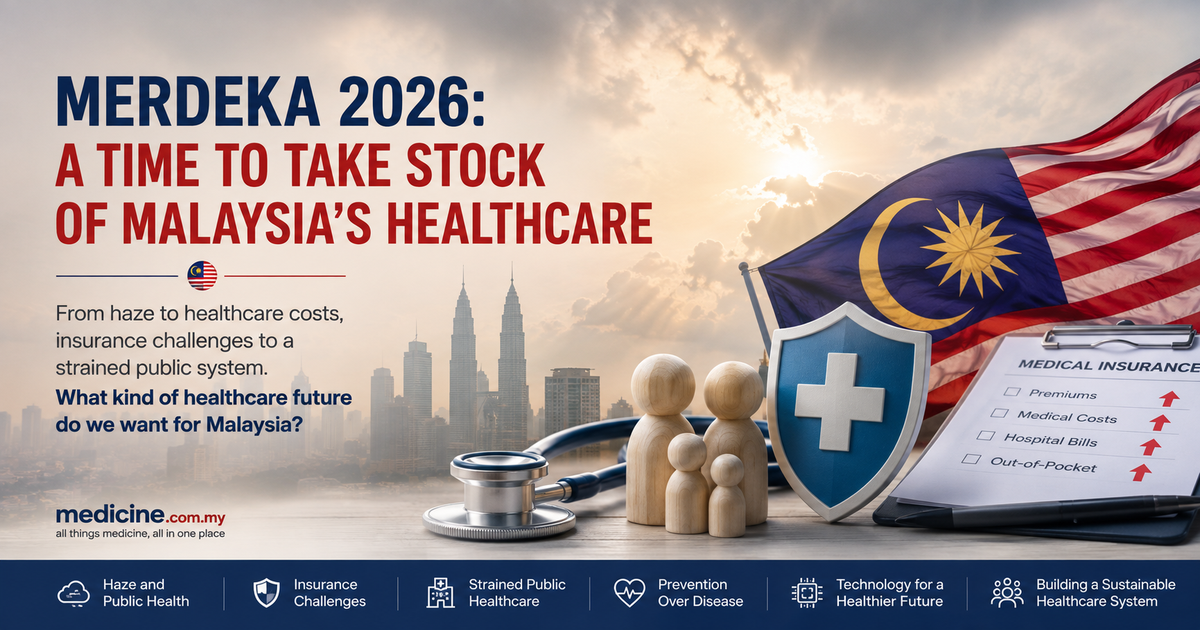
Merdeka Under Hazy Skies
There is something rather unfortunate about celebrating Merdeka this year with the haze hanging over us again. The air quality became serious enough that the Prime Minister’s National Day address was moved indoors from Dataran Merdeka, while Malaysia and Indonesia have again been dealing with forest fires and transboundary haze.
For Malaysians of a certain age, this all feels depressingly familiar. We have been through repeated episodes of haze for decades. The skies turn grey, everyone starts checking the API, people with asthma and other respiratory illnesses suffer, masks come out, and outdoor activities are curtailed. Eventually the rains arrive, the air clears and life goes back to normal. Then a few years later, we repeat the whole exercise.
It is a reminder that some problems cannot be solved by pretending borders make us independent of what happens around us. Pollution crosses borders. So do infectious diseases. Climate change certainly does not respect national boundaries.
In a way, the haze is also a rather appropriate backdrop to the state of healthcare in Malaysia today. We know there are serious problems ahead of us, but there is still a great deal of uncertainty about how we are going to solve them.
We Should Not Forget What Malaysia Got Right
It is easy to criticise the Ministry of Health today, particularly when we see crowded emergency departments, long waiting times and overworked healthcare workers. But we should not forget what Malaysia managed to build.
For decades, our public healthcare system delivered remarkably good healthcare for relatively modest national expenditure. Malaysians gained access to vaccination, maternal care, primary healthcare, surgery, dialysis, cancer treatment and increasingly sophisticated tertiary medicine. A Malaysian with a serious illness could enter a government hospital and receive treatment that might otherwise have cost tens or even hundreds of thousands of ringgit.
That is something we should be proud of.
The problem is that the Malaysia of 2026 is very different from the Malaysia for which much of this system was designed. We are living longer. We have more diabetes, obesity, hypertension, cardiovascular disease, kidney disease and cancer. Modern medicine can also do much more than it could 30 years ago. We have better imaging, better surgery, targeted cancer treatments, immunotherapy, transplantation and many other treatments that can prolong or save lives.
Unfortunately, many of these advances are expensive. We therefore have the combination of an ageing population, more chronic disease, greater public expectations and increasingly costly medical technology. It should surprise nobody that the healthcare system is struggling to keep up.
The Ministry of Health Cannot Be Expected to Carry Everything
For many years, the Ministry of Health has been Malaysia’s ultimate healthcare safety net. When someone cannot afford private treatment, they go to a government hospital. When their insurance coverage is exhausted, they may eventually end up in the government system. When long-term treatment becomes unaffordable privately, the public system is expected to take over.
This is one of the great strengths of Malaysian healthcare. Nobody seriously wants a country where someone is denied essential treatment simply because they are poor.
But there are limits to how much any system can absorb.
Those of us working in healthcare can see the pressure. Emergency departments are crowded. Clinics are busy. Beds are limited. Waiting lists grow. Doctors, nurses, pharmacists and other healthcare workers are expected to manage increasingly complicated patients while also dealing with enormous amounts of administrative work.
I would hesitate to say that the Ministry of Health is “collapsing”. That is probably too dramatic. But I think it is equally wrong to pretend that everything is fine simply because the system continues to function.
Systems rarely collapse overnight. They deteriorate gradually. Waiting times become longer, staff become exhausted, experienced people leave, and patients become frustrated. The quality of care becomes increasingly dependent on how hard individuals are prepared to compensate for deficiencies in the system.
That is not something we should allow to become normal.
Private Healthcare Is Not Immune Either
The traditional Malaysian answer to pressure on public healthcare has been the private sector. Those who could afford medical insurance or pay for treatment themselves could use private hospitals, which in turn reduced some of the burden on government facilities.
But that model only works if private healthcare remains reasonably affordable.
This is where we now have another problem.
Bank Negara Malaysia reported medical cost inflation of around 15% in 2024, considerably higher than the global and Asia-Pacific average of about 10%. As medical costs rise, insurers inevitably face higher claims, and those costs eventually feed through into higher insurance premiums.
The resulting repricing has caused considerable unhappiness. Bank Negara’s subsequent analysis showed that about 340,000 medical and health insurance or takaful policies were surrendered between January 2024 and June 2025 following repricing exercises.
That is a worrying number.
We should be careful about simply blaming insurance companies, however. Insurance is ultimately a mechanism for sharing risk. If hospitals, medicines, procedures and other components of healthcare become progressively more expensive, somebody has to pay for them. It might be the insurer, the patient, the employer or the government, but the cost does not disappear.
Bank Negara’s interim measures to spread some premium increases over several years may reduce the immediate pain for policyholders. They do not solve the underlying problem of medical inflation.
This is why MediAsas, which is being piloted in 2026 ahead of its planned introduction in 2027, is interesting. The idea of providing more affordable basic private medical coverage deserves serious consideration. But we should also be realistic about what it can achieve. MediAsas may improve access to insurance. It cannot by itself solve the much bigger question of how Malaysia finances healthcare.
We Need to Start Rewarding Health, Not Only Paying for Disease
There is another part of healthcare financing that I think deserves much more discussion.
At present, most of our healthcare system is designed around what happens after someone becomes sick. We pay for consultations, investigations, medicines, admissions and procedures. In other words, most of the money appears after disease has already occurred.
Perhaps we should think much more seriously about rewarding people for staying healthy.
Motor insurance provides an interesting analogy. If you drive for years without making a claim, you receive a No Claim Discount. The system gives you a financial incentive because you have represented a lower insurance risk.
Could we eventually introduce some of the same thinking into healthcare financing?
For example, people who stop smoking, maintain a healthy weight, exercise regularly, attend appropriate health screening and keep their blood pressure or diabetes under good control could potentially receive rebates, lower contributions or other incentives.
Obviously this has to be handled carefully. Nobody chooses to develop leukaemia, rheumatoid arthritis or many other illnesses. Genetics, ageing, socioeconomic circumstances and simple bad luck play major roles in health. We should never create a system that financially punishes people for becoming ill.
But there is also no point pretending behaviour has nothing to do with health. Smoking, obesity, physical inactivity and poorly controlled metabolic disease contribute enormously to the future burden on our healthcare system.
If Malaysia is serious about making healthcare sustainable, we need to spend more effort preventing illness rather than simply becoming increasingly efficient at treating its complications.
Technology Should Help Us Do More With the People We Have
Another area where Malaysia needs to move much faster is healthcare technology.
We have highly trained doctors, nurses, pharmacists and allied health professionals spending far too much of their time doing administrative work. Doctors type the same information repeatedly into different systems. Hospitals still depend on paper in places where the rest of the economy went digital years ago. Different electronic medical records often cannot communicate with each other.
Simply replacing a paper form with an electronic form is not digital transformation. Sometimes it merely creates digital bureaucracy.
This is also where artificial intelligence has a practical role. AI is not going to replace doctors and nurses, nor should that be the objective. The opportunity is to use AI to reduce documentation, summarise medical records, assist with administrative work, improve patient education and provide clinical decision support where appropriate.
If a doctor spends an hour typing information that software could safely prepare in a few minutes for the doctor to verify, we are wasting an expensive and increasingly scarce human resource.
Technology should give healthcare workers more time with patients, not give them another computer system to feed.
Ultimately, Somebody Has to Pay
This is perhaps the most difficult part of the healthcare debate.
Malaysians understandably want good healthcare. We want access to specialists, modern hospitals, the latest medicines and treatments, short waiting times and freedom to choose where we receive treatment.
We also want healthcare to remain affordable.
Unfortunately, there is no healthcare financing system anywhere in the world that can provide everything to everybody without limits.
Every system eventually makes choices. Some countries ration healthcare through waiting times. Some ration it through price. Others restrict which treatments will be funded. Insurance policies ration through coverage limits, exclusions, deductibles and co-payments.
Malaysia has been able to postpone some of these difficult discussions because our public healthcare system delivered extraordinary value for money for many years.
We cannot assume that this will continue indefinitely.
The real healthcare financing debate is therefore not simply about whether insurance premiums should increase or whether the government should spend more money. We need a much broader discussion about what healthcare Malaysians should be entitled to, how much society is prepared to spend on it, and how that cost should be shared between government, employers, insurers and individuals.
Those are politically difficult questions. But avoiding them does not make them disappear.
Malaysia Is at a Healthcare Crossroads
This Merdeka, I do not think we should be pessimistic about Malaysian healthcare.
We still have enormous strengths. We have excellent doctors, nurses, pharmacists and allied healthcare professionals. We have established public health infrastructure, good private hospitals, universities and medical schools. We also have technology available today that could dramatically improve the productivity of our healthcare system if we are prepared to use it properly.
But we should also stop assuming that the system which worked for the last several decades will automatically work for the next several decades.
We need sustainable healthcare financing. We need to address the underlying drivers of medical inflation rather than simply arguing about insurance premiums. We need to protect the public healthcare system while keeping private healthcare accessible enough to continue sharing the national burden. We need to put much greater emphasis on prevention and healthy living. And we need to use technology to make healthcare workers more productive rather than burying them under ever more administration.
Most importantly, we need to have this discussion honestly.
What Merdeka Should Mean
Merdeka naturally makes us look backwards. We remember 1957, the people who built this country and everything Malaysia has achieved since independence.
Perhaps we should spend a little more time looking forward as well.
Independence is ultimately about having the ability, and the responsibility, to determine our own future. Healthcare should be part of that conversation.
For the next generation of Malaysians, freedom should also mean being able to become seriously ill without financially destroying your family. It should mean being able to obtain good medical care without waiting until a disease has become advanced. It should mean having a healthcare system that encourages you to stay healthy rather than only appearing when you become sick.
And for those working inside healthcare, perhaps it should also mean being free to spend more time looking after patients and less time fighting bureaucracy.
Malaysia has come a very long way in 69 years. Our healthcare system has played an important part in that achievement.
Now we have to decide what we want it to become for the next 69.
Selamat Hari Merdeka.